


For over a decade, I’ve used a writing process that starts with expressive writing and ends with poetry. Not because I’m trying to be published in fancy literary journals (though that’s cool if it happens). But because turning my messy, chaotic thoughts into poems helps me make sense of who I’m becoming in this season.
And here’s the beautiful thing: you don’t need a literature degree to do this. You just need a willingness to write honestly and see what emerges.
Why Turn Expressive Writing Into Poetry?
You might be wondering: “Isn’t expressive writing enough? Why add the poetry step?”
Here’s what I’ve discovered: poetry writing encourages creative thinking through symbolism, metaphor, and imagery, and it can be both a cathartic release and a way to strengthen your sense of identity and voice PubMed CentralCenter for Atypical Language Interpreting (Bates 2012).
When you take your raw freewriting and shape it into something with “energy”—something that feels alive and true—you’re doing more than processing your feelings. You’re creating something that represents who you are right now, in this moment, in this season.
Poetry creates avenues for self-expression that cannot be felt through other means of communication, functioning as a self-guided therapy that allows you to strengthen your mental health and connection to yourself and to those around you PubMed (Sawhney et al. 2020).
Plus, you end up with something concrete—a poem—that you can return to later. It becomes a marker of where you were and how far you’ve come.
The Benefits of Creating Poetry (Beyond Just Processing)
The research on poetry writing shows some pretty incredible benefits:
For your mental health:
- Poetry therapy groups show significantly reduced levels of distress after just eight sessions PubMed Central (Bates 2012)
- Writing poetry forces the mind to slow down and revisit memories, often bringing to life past emotions and experiences in a dynamic process where writers learn new things about themselves PubMed (Sawhney et al. 2020)
- When we express emotions in writing, we validate them and give them a voice Center for Atypical Language Interpreting (Psychologs 2023)
For your sense of self:
- Writing poetry strengthens your sense of identity and voice, allowing you to represent yourself the way you want to be represented in the most honest and effective light PubMed (Sawhney et al. 2020)
- Poetry writing helps you analyze yourself and gain self-knowledge through inner reflection Center for Atypical Language Interpreting (Psychologs 2023)
For your creativity:
- Poetry writing encourages and supports creative thinking by placing strong emphasis on symbolism, metaphor, and imagery Center for Atypical Language Interpreting (Psychologs 2023)
My 7-Step Poetry Writing Process
This process is inspired by Thomas Lux’s “Not-So-Automatic Automatic-Writing Exercise” from The Practice of Poetry. I’ve been using it for over a decade, and it’s what I used to write through my burnout season and postpartum depression.
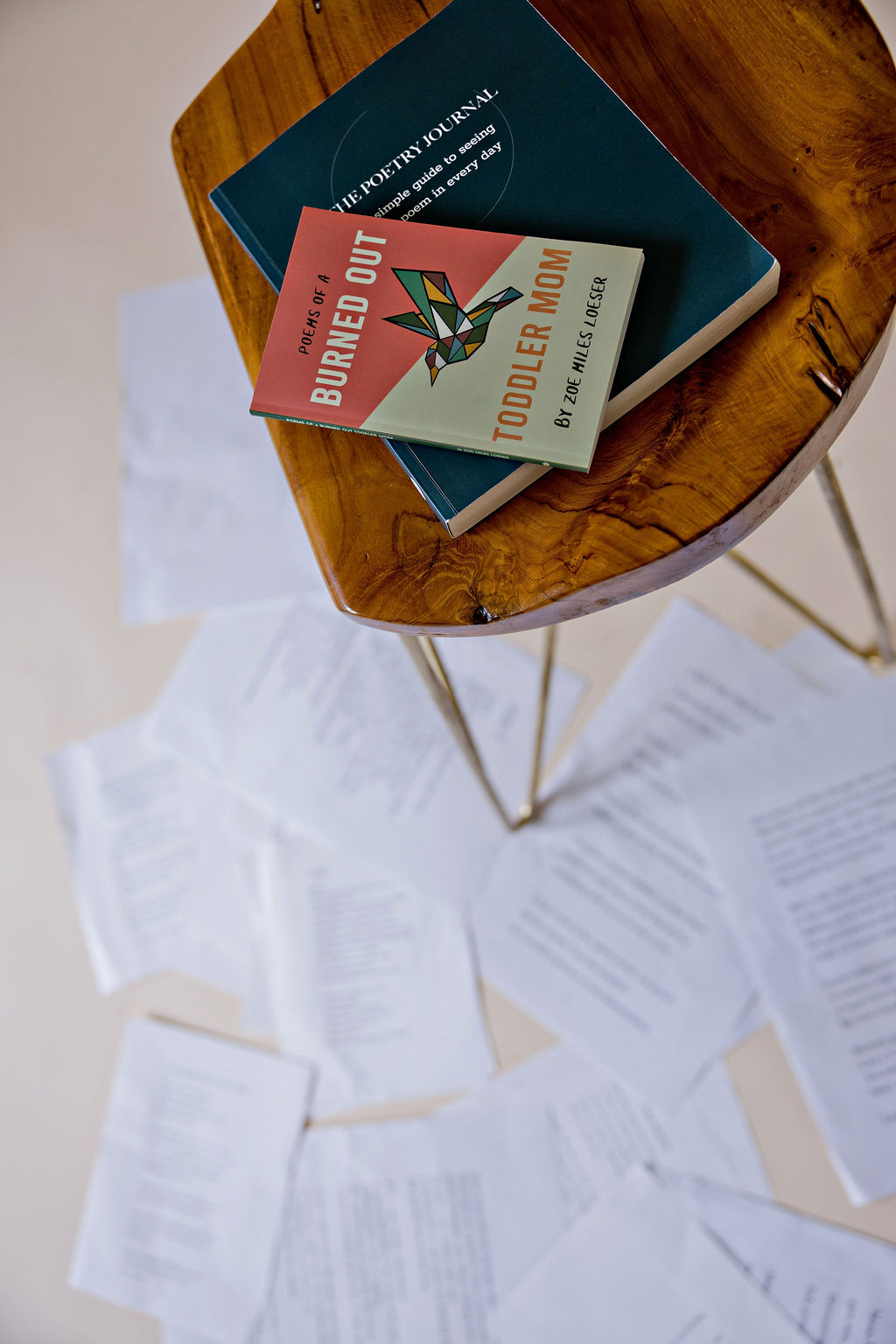
The poems in my book Poems of a Burned Out Toddler Mom came from this exact process.
Here’s how it works:
Step 1: Do a Focused Freewrite About Your Day
Time: Until you hit the end of a page or 5 minutes (whichever comes first)
Write anything about today without stopping to think, edit, or cross out. Repeat words if you need to.
This is expressive writing—the foundation. You’re getting your day out of your head and onto paper.
What to write about:
- The meeting that made you want to scream
- Your toddler’s meltdown
- Sunset while your kids drew with chalk
- Whatever’s taking up space in your brain
The rules:
- Don’t stop writing
- Don’t edit
- Don’t worry about making sense
- Repeat words if you get stuck
Step 2: Do a Wandering Freewrite
Time: Another page or 5 minutes
Follow your pen wherever it takes you without stopping to think, edit, or cross out.
This is where the magic starts happening. You’re not directing your thoughts anymore—you’re following them. Let your brain make connections you weren’t expecting.
You might start writing about your kid’s tantrum and end up writing about your own childhood. You might start with work stress and end up somewhere completely different. That’s perfect. Let it wander.
Step 3: Repeat Steps 1 and 2 Over Five Days
They do not have to be in a row. You’ll just do four of these before you move onto your next step. Don’t put more on yourself than is necessary.
Each writing session:
- One focused freewrite about your day
- One wandering freewrite following wherever it goes
Don’t read what you’ve written yet.
Step 4: Review Your Work and Highlight What Has Energy
After you have four writing sessions, read through everything you wrote.
What to look for:
- Phrases that make you pause
- Lines that feel true or alive
- Images that are vivid or surprising
- Moments where you surprised yourself
- Anything that gives you a physical reaction (your breath catches, your chest tightens, you feel something)
Highlight those parts. These are the pieces with “energy”—the raw material for your poem.
Step 5: Write Down Your Highlights and Group Them by Theme
Read through your highlights again. If a highlight still holds energy, write it down on a fresh page.
Then look for themes. What keeps coming up? What connects to what?
You might find:
- All the moments about feeling inadequate
- All the images about being touched out
- All the beauty in a cardboard castle
- All the phrases about love mixed with exhaustion
Group these together in whatever order makes the most sense. Add anything else that still has energy.
Congratulations—you just created your first draft!
Step 6: Edit Your First Draft Using These Guidelines
Now we’re going to make your poem stronger. Don’t worry—this isn’t about making it “good.” It’s about making it more true, more clear, more you.
Here are the editing guidelines:
1. Find abstractions and make them concrete Take a word you’ve used to describe an abstract idea—like love, faithfulness, or sadness—and write down what image that idea inspires. (Roses? Sunrise? Tissues?) Follow the image a line or two. Use that instead of or in addition to the abstract word.
2. Engage the senses Try to describe at least three of the five senses. What did it look like? Sound like? Feel like? Smell like? Taste like?
3. Use personification Find a place or thing that’s not human and make something about it human. (The sun’s fingers, the wind sighed, the house holds its breath)
4. Replace -ly words with stronger verbs Find any word that ends in -ly. Find the verb nearby. Can you remove the -ly word and replace the verb with a different verb that adds that same umph?
Example: “She sang loudly” becomes “She belted”
5. Replace “of” with apostrophes where possible “Mother of the bride” becomes “the bride’s mother”
6. Play with “like” and “as” Find anywhere you use “like” or “as.” Can you remove it and swap the word order?
Example: “Ugly as a monster” becomes “monster ugly”
7. Break grammar rules on purpose You’re allowed to break the rules, but do it intentionally, not accidentally.
8. Read it out loud How does it feel in your mouth? Fun? Quick? Bland? Play with word sounds, word arrangement, punctuation, and line breaks to evoke the sensations you want the poem to have.
If this feels too weird, skip it. (That applies to any of these guidelines.)
9. Cut unnecessary words Every word should earn its place. If it’s not adding meaning or music, consider cutting it.
Step 7: Rewrite Your Final Draft
After marking up your first draft with changes, rewrite the poem with all your edits.
Read it again. Mark any final changes.
Read it out loud one more time.
And then—you’re done. You created a poem. Good job!
What to Do With Your Poem
You have options:
Keep it private. This poem is for you. You don’t have to share it with anyone. It can live in your journal or your notes app as a marker of where you were in this season.
Share it with someone safe. Poetry is like a handshake—it creates bonds between people PubMed (Sawhney et al. 2020). Sharing your poem with a trusted friend, your therapist, or your partner can deepen connection.
Let it inform your next writing session. The themes that emerged in this poem might want more exploration. Follow them into your next four-writing-session cycle.
Celebrate it. You made something out of nothing. That’s worth celebrating, even if no one else ever sees it.
My Personal Experience With This Process
I took the writing I created through this process to therapy during my burnout season. I wrote through postpartum depression. I wrote when I quit my full-time job with two kiddos in tow and felt like a burned-out pile of ashes.
The poems didn’t fix everything. But they helped me understand what I was feeling. They helped me make sense of experiences that felt too big and chaotic to hold. They reminded me I was still a whole person underneath all the roles I was playing.
I hosted a poetry reading for my birthday (I wanted someone besides my therapist to bear witness—I’m a blast). A friend said, “This could be every mother’s poem, and it makes me feel so seen.”
That’s when I realized: this process isn’t just for me. It’s for all of us trying to figure out who we’re becoming while drowning in the demands of working motherhood.
These poems are now what make up my book Poems of a Burned Out Toddler Mom.
If You Want More Structure
Letting you in on a secret—I make off-brand stuff.
I know. Heresy.
But I’m an entrepreneur because I want to make what I want to make even if it…
- Isn’t for working moms
- Definitely adds to your to-do list
I call these my secret projects, and you can find this secret project here.→
I created a full poetry journal that walks you through this exact process with space to write, prompts to help you when you’re stuck, and guidance for each step.
The Poetry Journal includes:
- Pages for your five days of freewriting
- Space to highlight and group your energy
- The complete editing guidelines with examples
- Room for your drafts
Be warned. I made it for myself, so it’s like training for a marathon when couch-to-5k would be more your speed. It takes me a year to finish a journal and this is my full-time gig.
So if you’re not already a writer, you don’t need it. You can do this entire process with any notebook, the notes app on your phone, or the back of a napkin.
The tool doesn’t matter. What matters is that you’re giving yourself space to process, to create, to become.
A Few Important Reminders
You can’t fail at this. There’s no “right way” to write a poem. If you followed the steps and ended up with something that feels true to you, you succeeded.
It doesn’t have to be “good.” This isn’t about becoming a published poet (unless you want it to be). This is about using poetry as a tool for self-expression and healing.
The process is the point. Writing poetry itself can be a healing and restorative process, a self-guided therapy that allows you to strengthen your mental health and connection to yourself Center for Atypical Language Interpreting (Psychologs 2023). Even if you hate the poem you created, you still benefited from making it.
I’m not a therapist. I’m a certified Hope Navigator trained in Trust-Based Relational Intervention®, and I create tech-free mindfulness tools for working moms. This process can be therapeutic, but it’s not therapy. If you’re dealing with significant trauma or mental health concerns, please work with a professional. (I’m a big fan of therapists, treatment, and medication—#zoloft4life.)
Ready to Try It?
Here’s your assignment:
Today: Do a focused freewrite about your day (one page or 5 minutes)
Then: Do a wandering freewrite (another page or 5 minutes)
Repeat for four writing session across any amount of time.
Then: Follow steps 4-7 to turn your freewriting into a poem.
You’re going to be amazed at what emerges when you give yourself permission to write honestly and see where it leads.
This season is hard. You’re drowning in the impossible math of being present for your kids AND your job. But underneath all that chaos, you’re still you. You’re still becoming someone.
Poetry can help you remember that. It can help you witness yourself, honor your experience, and create something beautiful out of the mess.
You’re doing such a good job. People are in awe of what you’re accomplishing.
The world’s a better place because you’re in it.
And I’m so glad that you’re you.
Want More Support?
Try expressive writing first: If you want to start with the foundation of this process, read my guide on how to use expressive writing to process trauma and today.
Carry hope in your pocket: My book Poems of a Burned Out Toddler Mom was created using this exact 7-step process during my burnout season. It’s designed to be the high-hope friend you can turn to when you need someone to remind you you’re doing a good job.
Get the full poetry journal: The Poetry Journal includes this complete 7-step process with guided pages, prompts, and space to create 20 poems.
Join the weekly hug: Hop on the email list for working moms that brings encouragement, validation, and four ten-second activities each week to boost your happy brain chemicals. Find out why it has an open rate 20% above industry average.
Keep showing up for yourself—you’re doing great.
References
Bates, V. (2012). Mindfulness in the green mind: Poetry for presence. Journal of Poetry Therapy, 25(1), 21-32.
Mazza, N. (2004). The healing power of writing: Applying the expressive/creative component of poetry therapy. Journal of Poetry Therapy, 17(3), 141-154.
Psychologs. (2023, September 16). Healing verse: The therapeutic benefits of writing poetry. https://www.psychologs.com/healing-verse-the-therapeutic-benefits-of-writing-poetry/
Sawhney, N., Garibaldi, K., Ludmir, G., & Amgalan, A. (2020). A look back and a path forward: Poetry’s healing power during the pandemic. Journal of Radical Wonder: Art, Science, Philosophy, and Human Being, 2(2).


View comments
+ Leave a comment